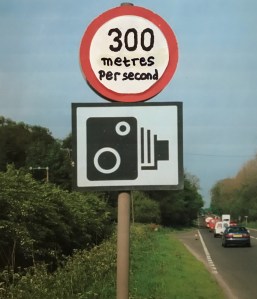
Did you ever get the feeling that time is passing much more quickly than it used to? Remember that yawning chasm of the summer holidays just starting? Those days so long that you could smell the grass growing as you slithered through it, a prowling Indian with bow and arrow pouncing on your careless cowboy friends? Remember how long the school year was when you didn’t like your teacher? How long the walk home in the winter sleet when your bare knees were freezing and purple?
I read today that in summer molecules move at 430 meters per second, while in winter it is only slightly less! Is it any wonder that we feel we have to live at breakneck speed these days? Going to bed around two in the morning once, when we had to be up at six, a friend once commented wearily to me “never mind, we’ll just have to sleep faster”.
Of course it’s nice to know that when it’s icy and frosty outside those molecules are at least slowing down a bit. After all if they slip then time will move even more quickly won’t it? There you might be trundling along, a contented 25-year-old and then “oops!” one speeding molecule and you’re slipping into old age before you can say “minimum pension contributions”.
In summer too they’re fairly dashing along, when you’d think they might want to take things a bit easier. Many’s the time I’ve headed out to my dusty hammock in the fruit trees with a book in my hand and a pillow under my arm, only to find that a posse of irritating molecules has got there before me and splattered it with bird poop. Or just when I’ve planned to sit in the shade of the crabapple tree and study the caddis flies in the pond, suddenly the grass is two feet longer than it was yesterday and demanding to be cut right now. Molecules again. I head out to the vine to make sure the birds haven’t eaten the grapes only to find an advance squadron of molecules on the grass in a drunken heap of mushy fruit.
Here on our island the warmer weather can be hazardous too. For example we often have a layer of pollen on the roads which again might cause a speeding molecule to slip and do heaven only knows what damage to the space-time continuum. Our local molecules are generally familiar with our island’s perils but if visiting molecules go charging dangerously about then it can be a problem.
I can testify that in large hospitals molecules move very fast indeed. This is particularly challenging for nurses since as everyone knows, nurses are not allowed to run except in cases of fire, cardiac arrest and tea break. There’s no doubt that it was a bit of a trial for us at times keeping up with those supersonic atoms. Fire and cardiac arrest don’t tend to happen very often. Tea breaks however happen at least once per shift so they were our big chance to give those particles a bit of a run for their money. It was generally thought that we were rushing to tea break because we only had 15 minutes and it was a 7 minute walk to get there and another 7 minute walk to get back, but now of course it is widely known that we were rushing to keep up with those dratted molecules. (It certainly wasn’t on account of the canteen’s food.)
Not that there aren’t times we’d all like our molecules to move a bit faster – but let’s face it, it simply may not be possible. The next time my internet speed makes me wonder if some of my service provider particles have gone on strike, I’m going to bear in mind that they may have been caught up in one of those hair dryer-type things the police sometimes wave around when they sit at the roadside measuring molecules.
 The Blethering Ant