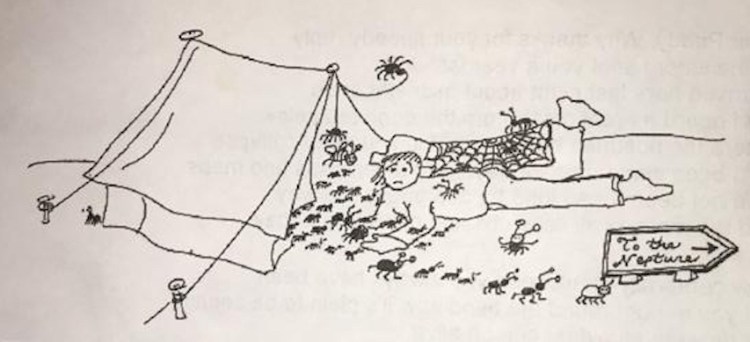
The subterranean termite is a social, wood-devouring insect, invasive, destructive and below my cabin. And dead. Discovered about a month ago, its whereabouts were unclear for some time and the suspicion that it had been tipped off and had defected to another location was proven to be false, as was the rumour that it was acting alone. Responding to the probable end of the dry season, its operatives emerged from their hideout accompanied by many thousands of their family and friends, their families, their friends and families, neighbours, co-workers, soldiers and an investigative journalist from the CBC. As the swarms appeared they were picked off one by one by my crackshot sharpshooting assistant, P.A. Nasonic. A later attack by The Pest Doctor from Nanaimo using AK-47 assault rifles, hand grenades and residual pyrethroid insecticide ensured victory.
Yes, it’s true. Not content with sending me woodlice, fruit flies, carpenter ants, giant slugs, tent caterpillars, white pine blister rust, powdery mildew and pea moths, the Great Jungles of the Pacific Northwest have awarded me with their pièce de resistance, the western subterranean termite. But what is it? A quick search on the internet turns up intriguing results. I type “subterranean” and the first thing I see is “Subterranean Homesick Blues”, and learn that Johnny is in the basement, mixing up the medicine. Well he’s a little late in doing that now I must say, since they’ve been dead over a week and The Termite Man (recognizable by his broadly jointed waist and straight antennae) wanted considerably more than eleven dollar bills. And he wasn’t wearing a coonskin cap either.
As usual, the internet is a mine of information. Termites exude defensive secretions through holes in their heads, I read. They sometimes practice agriculture, live in nests lined with faeces, feed on dung, and are delicious, highly nutritious snacks. Why do I have the feeling that those last two qualities are mutually exclusive?
Termites it seems, apart from being pretty tasty, are actually quite useful in other ways, breaking down dead and fallen trees and other sources of cellulose in forests. Regrettably however, they are not knowledgeable arborists and may also attack wooden structures. “You mean they think my house is a tree?” I ask The Termite Man. “That’s about it,” he replies. That’s torn it, I sigh. And I’d been planning on getting one as a pet from the local Termite Rescue Society. “Harvey! Get down from there! I’ve told you before about eating the ceiling joists! Come to heel this instant!”
I also discover that termite colonies will fight each other as well as carpenter ants who are their mortal enemies. Well goodness if I’d known that I might have spared the 2007 infestation of carpenter ants, and kept them on the staff for their combative powers. No matter – the battle is – so far as we know – now won, and all I have to do is turn my house into a metal box to prevent their recurrence. If I suspect they may be planning a comeback I should “listen for the tapping of soldiers.” Hmm. That could be a tricky one. We don’t get many soldiers around here, but as in all the best folk songs I will tie a little string around my finger, put the end out of my room window and hope.
2015-10-14
 The Blethering Ant